Quick answer
This glossary explains the printing, finishing, paper, postage and data terms you'll come across when buying print or direct mail, from bleed and CMYK to Mailmark, PAF and saddle stitching. Each definition is short and in plain English. Where a term has its own in-depth guide, the definition links to it. Every term also has its own link, so you can share a single definition with a colleague or client.
Key takeaways
- Artwork terms (bleed, safe area, DPI, CMYK, PDF/X) decide whether your files print as intended. Get them right before anything goes to press.
- Paper is described by weight (GSM), thickness (caliper) and finish (gloss, silk, matt or uncoated). Weight and thickness are not the same thing.
- Litho and digital printing suit different run lengths. Make-ready, plates and run length are the terms that explain the cost difference.
- Postage savings come from sortation, Mailmark barcodes and services such as Advertising Mail, so format and data quality matter as much as print.
- Data terms (PAF, NCOA, MPS, suppression, controller and processor) are about accuracy and compliance. They protect your budget and your reputation.
A
- A/B test
- Sending two or more versions of a mailing (different offers, formats or copy) to matched, randomly split groups so the response of each can be compared. Every version needs its own response code so results can be attributed. See how to plan a direct mail campaign.
- Acquisition mailing
- A mailing sent to people who are not yet customers or supporters, usually to a rented or bought list or a partially addressed audience. Also called cold mail. See how to rent or buy a mailing list.
- Advertising Mail
- Royal Mail's discounted service for addressed letters and large letters whose content is advertising, marketing or promotional. Items must meet Royal Mail's content rules to qualify. See Royal Mail Advertising Mail explained.
- Aqueous coating
- A clear water-based coating applied over printed ink, often inline on a litho press, to protect the surface, speed up drying and add a gloss, silk or matt sheen. Also called seal or press coating.
- Artwork
- The finished design files supplied for print, usually as a print-ready PDF. See how to set up artwork for print.
B
- B2
- A paper sheet size of 500 × 707mm, and the shorthand for the class of sheetfed litho presses built around it. A B2 sheet holds four A4 pages on each side, so one sheet makes an eight-page A4 section. See paper sizes.
- Bereavement suppression
- Removing records of people who have died from a mailing file by matching against deceased registers such as The Bereavement Register. Mailing someone who has died causes real distress to their family. See data cleansing for mailings.
- Bleed
- Artwork that extends past the trim edge, normally by 3mm on every trimmed side, so there is no white sliver if the cut moves slightly. See how to set up artwork for print.
- Board
- Heavy paper, generally above about 300gsm, used for covers, cards, folders and packaging. See paper weight and GSM.
- Business reply
- A Royal Mail licence that lets you include a pre-printed reply envelope or card that the recipient can post back without a stamp. You pay only for the replies that come back. Freepost is the related licence where respondents write a short Freepost address on their own envelope.
C
- Caliper
- The thickness of a sheet of paper or board, usually measured in microns (thousandths of a millimetre). Caliper, not just GSM, decides a book's spine width and whether an item fits a letterbox or envelope.
- Case binding
- Hardback binding: the pages are sewn or glued into sections and attached to rigid board covers. See binding methods.
- Chain of custody
- Certification that tracks certified material, such as FSC paper, through every company that handles it, so a printed product can carry a certification label. Fretwell holds FSC chain of custody certification. See FSC certification explained.
- CMYK
- Cyan, magenta, yellow and key (black): the four process ink colours used to print full-colour images. Artwork built in RGB has to be converted to CMYK for print. See CMYK vs RGB vs Pantone.
- Coated paper
- Paper with a surface coating, typically clay-based, that holds ink on the surface for sharper images and brighter colour. Gloss and silk are coated finishes. See silk vs gloss vs uncoated paper.
- Colour management
- Controlling colour from screen to proof to press using measured profiles and standards, so the result is predictable on every device. Fretwell's presses are colour-managed to FOGRA standards.
- Contract proof
- A colour-accurate printed proof, made to an agreed standard such as ISO 12647-2, that the press aims to match. It is signed off as the colour reference for the job.
- Control pack
- The current best-performing version of a mailing. New ideas are tested against it, and a new version only replaces it if it beats it on response or cost per response.
- Cost per response
- The total cost of a campaign divided by the number of responses it generates. A useful way to compare formats and channels with very different unit costs. See direct mail response rates and ROI.
- Creasing
- Pressing a line into card or heavy paper so it folds cleanly without cracking. Also called scoring. See leaflet folds explained.
- Creep
- In a saddle-stitched booklet, the inner pages push out further than the outer pages, so their outer margins get trimmed more. Imposition software compensates by shifting pages slightly. Also called shingling.
- Crop marks
- Thin lines printed outside the trim area that show where the sheet should be cut. Also called trim marks.
- Cross fold
- Folding a sheet in half and then in half again at right angles, producing eight pages from one sheet. Also called a French fold. See leaflet folds explained.
D
- Data controller
- Under UK GDPR, the organisation that decides why and how personal data is used. For a mailing, the brand or charity sending it is normally the controller. See GDPR and direct mail.
- Data processor
- Under UK GDPR, an organisation that handles personal data on a controller's instructions, under a written contract. A mailing house printing and posting your mailing acts as a processor. See how we keep your data secure.
- Debossing
- Pressing a design into paper or board so it sits below the surface. The opposite of embossing. See print finishes explained.
- Deduplication
- Finding and removing duplicate records in a mailing file, so no one receives two copies of the same pack. Also called dedupe, or merge-purge when several lists are combined. See data cleansing for mailings.
- Die cutting
- Cutting paper or board into a non-rectangular shape with a custom-made cutting forme. Used for packaging, folders, pop-ups and shaped mailers.
- Digital printing
- Printing straight from the file without plates, so every sheet can be different and short runs are economical. See litho vs digital printing.
- Direct mail
- Marketing or information sent by post to a named person or address. See the complete guide to direct mail marketing.
- DL
- A paper and envelope format of 99 × 210mm (paper) or 110 × 220mm (envelope), sized to take an A4 sheet folded twice. See envelope sizes.
- Door drop
- Unaddressed leaflets or samples delivered to every letterbox in chosen postcode areas, by Royal Mail or a private distributor. See door drop marketing.
- Dot gain
- The way halftone dots spread as ink is absorbed into paper, making images print darker than the file. It is greater on uncoated stock. Also called tone value increase. See silk vs gloss vs uncoated paper.
- Downstream access
- An arrangement where a mailing house or postal operator collects and sorts mail, then hands it to Royal Mail for the final delivery. It can reduce postage on large mailings. See what is a mailing house.
- DPI
- Dots per inch: the resolution of an image or output device. For print, photographs should be 300dpi at the size they will appear. See how to set up artwork for print.
- Drilling
- Punching holes through finished print so it can go in a ring binder or be tagged.
E
- Embossing
- Pressing a design up from the back of paper or board so it stands proud of the surface. Blind embossing has no ink or foil. See print finishes explained.
- Enclosing
- Inserting the components of a mailing pack (letter, leaflet, reply device) into an envelope, usually on automated machines that read codes to keep personalised items together. Also called inserting. Fretwell encloses on Buhrs lines.
- Envelope sizes
- The C series (C4, C5, C6) sized to take A-series paper flat or folded, plus DL. See envelope sizes.
F
- Finishing
- Everything that happens to print after it leaves the press: cutting, folding, creasing, binding, laminating, foiling and so on. See print finishes explained.
- Five-colour press
- A litho press with five printing units: CMYK plus one for a Pantone spot colour or a special ink. Fretwell runs a five-colour Heidelberg Speedmaster XL 75.
- FOGRA
- A German print research institute whose colour standards and characterisation data (such as FOGRA39 and FOGRA51) are widely used to colour-manage European litho and digital print.
- Foil blocking
- Applying metallic or coloured foil to paper using heat and pressure through a metal die. Also called hot foil stamping. See print finishes explained.
- Franking
- Printing a postage mark with a franking machine instead of using stamps. Bulk mailings normally use sorted services and a printed postage impression instead.
- FSC
- The Forest Stewardship Council, which certifies that wood and paper come from responsibly managed forests and other controlled sources. See FSC certification explained.
- Fulfilment
- Storing printed or promotional items and sending them out on demand, for example brochure requests, samples or welcome packs.
G
- Gate fold
- A fold where both outer panels fold in to meet in the middle, like a pair of doors. See leaflet folds explained.
- GDPR
- The UK General Data Protection Regulation, which governs how personal data, including names and addresses for mailings, is collected and used. See GDPR and direct mail.
- Gloss paper
- Coated paper with a shiny finish that gives images the most contrast and saturation. See silk vs gloss vs uncoated paper.
- Goneaway
- A person who no longer lives at the address on file. Goneaways are removed by matching against change-of-address and goneaway files before mailing. See data cleansing for mailings.
- Grain direction
- The direction most fibres lie in a sheet of paper. Paper folds more cleanly along the grain, so grain matters for creasing, binding and how a booklet opens.
- GSM
- Grams per square metre: the weight of paper. Higher GSM is generally heavier and stiffer, but not always thicker. See paper weight and GSM.
H
- Halftone
- A pattern of tiny dots of varying size used to reproduce continuous-tone images with a limited number of inks.
I
- Imposition
- Arranging pages on a press sheet so that once it is printed, folded and trimmed, they appear in the right order and the right way up.
- Inkjet personalisation
- Adding names, addresses, barcodes or variable text to pre-printed items with high-speed inkjet heads, often on the enclosing line.
- Inline coater
- A coating unit on a litho press that applies an aqueous or UV coating in the same pass as printing. Fretwell's B2 Heidelberg presses have inline coaters.
- ISO 12647-2
- The international standard for process control in offset litho printing. It defines target colour values so proofs and press sheets can be matched.
- ISO 14001
- The international standard for environmental management systems. Fretwell is ISO 14001 certified. See sustainable printing.
- ISO 27001
- The international standard for information security management. Mailing houses use it to show how they protect customer data. See how we keep your data secure.
- ISO 9001
- The international standard for quality management systems.
K
- Key code
- A code printed on a reply device or used in a URL or offer code that identifies which list, version or test cell a response came from. Also called a source or response code.
- Knockout
- Removing the colour beneath an overlapping object, so the top colour prints directly on paper rather than on another ink. The opposite of overprint.
L
- Lamination
- A thin plastic or biodegradable film bonded to printed sheets for protection and feel. Common types are gloss, matt and soft-touch. See print finishes explained.
- Large letter
- A Royal Mail size format for items larger than a standard letter, such as a C4 envelope or a thick pack. Format has a big effect on postage. See letter vs postcard vs self-mailer.
- Legitimate interests
- A lawful basis under UK GDPR that many organisations rely on for postal marketing, provided they carry out a balancing test and respect objections. See GDPR and direct mail.
- Lettershop
- The department of a mailing house that personalises, folds, encloses and sorts mailings. See what is a mailing house.
- Litho printing
- Offset lithography: ink transfers from a metal plate to a rubber blanket and then to paper. It is economical for longer runs and supports Pantone spot colours. See litho vs digital printing.
M
- Mailing house
- A company that prepares and posts mail in bulk: data processing, printing, personalisation, enclosing and sortation. See what is a mailing house.
- Mailing list
- A file of names and addresses used for a mailing. It can be your own customer data or rented or bought from a list owner. See how to rent or buy a mailing list.
- Mailmark
- Royal Mail's barcode system for business mail. Each item carries a unique barcode that enables tracking and reporting, and barcoded mail is priced below non-barcoded equivalents. See Mailmark explained.
- Make-ready
- Setting up a press before a run: mounting plates, loading stock and adjusting ink and registration until the sheets are right. Make-ready is a fixed cost that is spread over the run.
- Matching
- Checking on the enclosing line that personalised components for the same recipient (for example a letter and a reply form) go into the same envelope, usually by reading printed codes.
- Matt paper
- Coated paper with no sheen, giving a flat finish that is easy to read under bright light. See silk vs gloss vs uncoated paper.
- MPS
- The Mailing Preference Service: a free register for people who don't want unsolicited addressed advertising mail. Mailings to prospects should be screened against it. See Mailing Preference Service explained.
How we can help
UK direct mail, start to finish
Data processing, personalisation, enclosing and Royal Mail Mailmark sortation, all in-house at our Keighley site.
Explore the serviceN
- NCOA
- National Change of Address: Royal Mail's file of people who have moved and set up a mail redirection, used to update or suppress old addresses. See data cleansing for mailings.
- NCR
- No carbon required: chemically coated paper that copies writing or impact printing onto the sheets below, used for invoice and delivery-note sets.
O
P
- PAF
- The Postcode Address File: Royal Mail's database of UK delivery addresses and postcodes, used to check and correct address data before mailing. See data cleansing for mailings.
- Pantone
- The Pantone Matching System, a library of numbered spot colours mixed from base inks to an exact recipe. Used for brand colours, metallics and fluorescents. See CMYK vs RGB vs Pantone.
- Paper sizes
- The ISO A series (A0 to A8) and B series, where each size is half the one before. See paper sizes.
- Partially addressed mail
- Mail delivered to an address without a name, for example "The Resident", where addresses are chosen by postcode using profiling data. See partially addressed mail.
- PDF/X
- A family of ISO standards (such as PDF/X-1a and PDF/X-4) for reliable print-ready PDFs, with fonts embedded and colour defined for print. See how to set up artwork for print.
- PECR
- The Privacy and Electronic Communications Regulations, which cover marketing by email, text and phone. They do not cover addressed post, which falls under UK GDPR. See GDPR and direct mail.
- Perfect binding
- A binding where the pages are glued into a cover at a squared spine, as in a paperback. PUR is a stronger version. See binding methods.
- Perforation
- A line of small cuts that lets part of a printed item, such as a reply slip or voucher, be torn off neatly.
- Personalisation
- Changing content for each recipient, from a name and address to tailored offers, images and copy. See variable data printing.
- Plates
- The thin aluminium sheets, one per colour, that carry the image on a litho press. Platemaking is part of litho's set-up cost.
- Polywrap
- A thin plastic film wrapped around a magazine or catalogue for mailing. Paper wraps and compostable films are common alternatives.
- Postage paid impression
- A printed mark in place of a stamp, showing that postage for a bulk mailing has been paid under an account. Usually shortened to PPI.
- Postcard
- A single card mailed without an envelope. It is cheap to produce and is seen immediately. See letter vs postcard vs self-mailer.
- Preflight
- Checking print files before production for problems such as missing bleed, low-resolution images, RGB colour or unembedded fonts. See the print artwork checklist.
- Print brief
- A short document that sets out a print job's purpose, specification, quantities, deadlines and delivery. See the print brief template.
- Process colour
- A colour made by combining the four CMYK inks, as opposed to a pre-mixed spot colour.
- Proof
- A preview of the job for checking and approval before printing: a PDF soft proof for content, or a printed hard proof for colour. See the print proofreading checklist.
- PUR binding
- Perfect binding with polyurethane reactive adhesive, which is stronger and more flexible than standard hot-melt glue, so books open flatter and pages don't fall out. See binding methods.
How we can help
Commercial litho and digital print
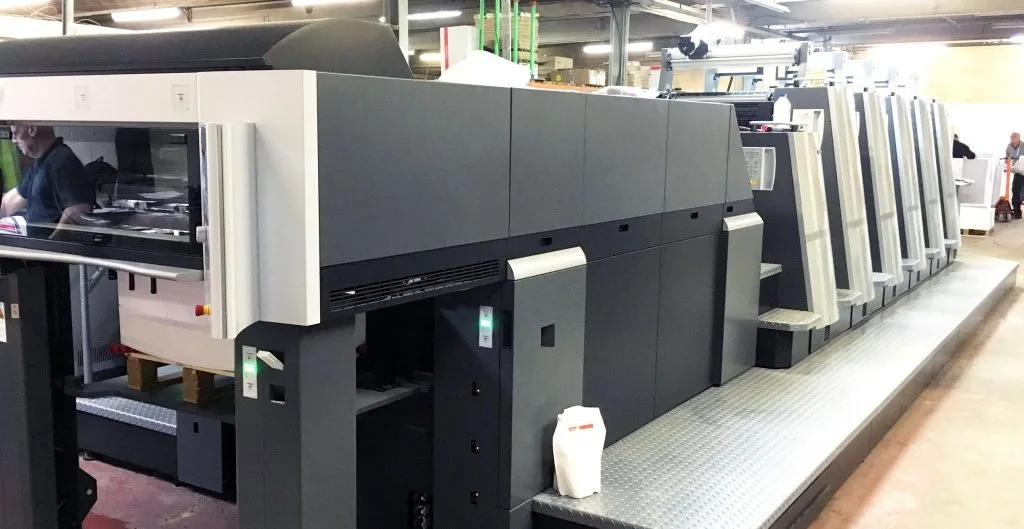
B2 Heidelberg litho and Versafire digital presses, with binding and finishing completed under one roof.
Explore the serviceR
- Raster
- An image made of pixels, such as a photograph. It loses quality if enlarged beyond its resolution. Compare vector.
- Recycled paper
- Paper made partly or wholly from recovered fibre. Recycled content is stated as a percentage. See sustainable printing.
- Registration
- Aligning the separate colour plates or print passes so they sit exactly on top of each other. Poor registration causes coloured fringes.
- Response device
- The part of a mailing that the recipient uses to reply: a reply form, coupon, card or envelope, a QR code or a personalised URL.
- Response rate
- The number of responses divided by the number of items mailed. Rates vary widely by sector, list and offer. See direct mail response rates.
- Retention mailing
- A mailing to existing customers or supporters, intended to keep them buying or giving. Also called warm mail. See donor retention and warm appeal mailings.
- RGB
- Red, green and blue: the light-based colour model used by screens. RGB colours can look duller when converted to CMYK for print. See CMYK vs RGB vs Pantone.
- Rich black
- Black built from black ink plus some cyan, magenta and yellow, giving a deeper solid than black ink alone. Not suitable for small text.
- Roll fold
- A fold where panels roll inward on one another. Each panel is slightly narrower than the last so it sits neatly inside. See leaflet folds explained.
- Run length
- The number of copies printed. Run length largely decides whether litho or digital is cheaper. See litho vs digital printing.
S
- Saddle stitch
- Binding by folding sheets and stapling them through the spine fold. Page counts are in multiples of four. See binding methods.
- Safe area
- The margin inside the trim edge where important text and logos should stay, typically at least 5mm in, so nothing is cut off. Also called the quiet area. See how to set up artwork for print.
- Seed
- A dummy record of a real, controlled address added to a mailing file so the sender receives a copy and can check the mailing's timing and quality.
- Self-mailer
- A printed item that is mailed without an envelope, folded and sealed so it carries its own address. See letter vs postcard vs self-mailer.
- Sheetfed
- A press that prints on separate sheets rather than a continuous reel. Most commercial litho and digital presses are sheetfed.
- Show-through
- Print on one side of a sheet showing through on the other. Thicker, more opaque paper reduces it.
- Silk paper
- Coated paper with a smooth, low-sheen finish between gloss and matt. A popular all-rounder for brochures and leaflets. See silk vs gloss vs uncoated paper.
- Soft-touch lamination
- A matt laminate with a velvety feel, often used on premium covers and business cards. See print finishes explained.
- Sortation
- Sorting a mailing by postcode to the level Royal Mail or another operator requires for a price tier, and presenting it in labelled trays or bags. Sortation is where most postage savings come from. See Mailmark explained.
- Spine
- The bound edge of a book or booklet. On a perfect-bound book it is a flat, printable surface whose width depends on page count and paper caliper. See binding methods.
- Spot colour
- A pre-mixed ink printed as its own colour rather than built from CMYK, usually specified as a Pantone reference. See CMYK vs RGB vs Pantone.
- Spot UV
- A clear, glossy UV-cured varnish applied to selected areas of a design, often over matt lamination for contrast. See print finishes explained.
- SRA3
- An oversized sheet (320 × 450mm) that can hold an A3 page plus bleed and crop marks. It is a common sheet size on digital presses. See paper sizes.
- Stock
- Printers' shorthand for the paper or board a job is printed on.
- Suppression file
- A list of records to remove from a mailing, such as goneaways, deceased, MPS registrations or people who have asked not to be mailed. See data cleansing for mailings.
T
- Total ink coverage
- The combined percentage of CMYK ink in the darkest part of an image. Too much ink can cause set-off and slow drying, so profiles cap it. Also called TAC.
- Trim
- The final size of a printed piece after cutting. See also bleed and crop marks.
U
- Uncoated paper
- Paper with no surface coating. It is natural to the touch, easy to write on and absorbs more ink, so colours print softer. See silk vs gloss vs uncoated paper.
V
- Variable data printing
- Digital printing in which text, images or codes change from one item to the next, driven by a data file. See variable data printing.
- Varnish
- A clear ink-like coating, applied all over or as a spot, to protect print or add sheen. See also aqueous coating and spot UV.
- Vector
- Artwork made of mathematically defined shapes, such as logos and type, that stays sharp at any size. Compare raster.
W
- Window envelope
- An envelope with a clear panel through which the address printed on the letter shows, so the letter and envelope always match. See envelope sizes.
- Wiro binding
- Binding with a double loop of wire through punched holes, so a document opens flat and folds back on itself. See binding methods.
Z
- Z fold
- A sheet folded twice in opposite directions so it opens out in a zigzag. See leaflet folds explained.
Sources
- Royal Mail Wholesale – Royal Mail Mailmark
- Royal Mail – User Guide for Royal Mail Advertising Mail, April 2026 (archived copy)
- Royal Mail Marketreach – Partially addressed mail
- Royal Mail – Powered by PAF (Postcode Address File)
- MPS – About the Mailing Preference Service (corporate)
- ICO – Plan direct marketing (postal marketing, MPS and suppression lists)
- legislation.gov.uk – UK GDPR Article 28 (processor)