Quick answer
Door drop marketing means delivering unaddressed leaflets, brochures or samples to every household in the areas you choose. In the UK you can book it through Royal Mail Door to Door, which delivers with the daily post and reaches all 32 million UK addresses, or through an independent leaflet distributor, either solus (your item on its own) or shared (with other leaflets or a free paper). Royal Mail's 2026 standard price for a 20g item starts at £84.00 per 1,000 items, with a £200 minimum charge. Door drops average a 0.3% response rate but £4.00 back for every £1 spent (JICMAIL), because the cost per household is low.
Key takeaways
- Royal Mail Door to Door reaches all 32 million UK addresses, delivered by your post person with the daily mail (Royal Mail Price Guide, April 2026).
- 2026 standard prices are charged per 1,000 items by weight: £84.00 at 20g, £117.60 at 60g and £149.52 at 100g for up to 25,000 items. There is a £200 minimum charge per contract, plus VAT and a 0.3% JICMAIL levy.
- Keep items under 5mm deep to book online. Anything 5mm or deeper has to be booked through the Door to Door Booking Centre.
- Door drops stay in the home for 6.0 days on average and earn 70 seconds of attention (JICMAIL, Q2 2026).
- Response averages 0.3%, but return on investment averages £4.00 per £1 (JICMAIL Response Rate Tracker). Build tracking into the leaflet from the start.
What is a door drop?
A door drop is a printed item delivered through the letterbox without a name or address on it. Instead of mailing a list of people, you choose areas, and every household (or every residential address) in those areas receives the item. That makes door drops a natural fit for local businesses, store openings, seasonal offers, new services and any campaign where you want broad reach in a defined patch.
Because no personal data is used to address the item, you do not need a mailing list. The trade-off is that you cannot personalise the message to the individual, so targeting depends on choosing the right areas. If you want to reach named customers or look-alike households at a specific address, see our comparison of addressed mail, partially addressed mail and door drops.
Your distribution options
| Royal Mail Door to Door | Solus distribution | Shared distribution | |
|---|---|---|---|
| Who delivers | Your Royal Mail post person, with the daily mail | An independent distributor's team, delivering your item on its own | An independent distributor, alongside other leaflets or with a free newspaper or magazine |
| Coverage | All 32 million UK addresses | The distributor's own areas | Areas where the shared round or free paper runs |
| Competing messages | Royal Mail says your item won't go out with a competing message | None: your item goes alone | Your item travels with others; ask how competitors are kept apart |
| Relative cost | Rate card price per 1,000 by weight | Usually higher than shared, as the round carries one item | Usually the cheapest per item |
| Good for | Wide or national coverage and reliable delivery | Standing out locally, larger or premium items | Low-cost local awareness |
Ask any independent distributor how they check delivery, whether that is GPS tracking of teams, spot checks or audit reports, and whether they are a member of the Data & Marketing Association (DMA). The DMA recommends using members, who follow its code of practice.
Door drops in Ireland
In the Republic of Ireland, An Post's unaddressed service is Publicity Post. We manage print, enclosing and delivery into the An Post network on our own account. See direct mail to Ireland.
How door drop targeting works
Door drops are booked by area rather than by name. With Royal Mail Door to Door you choose postcode sectors, and the Door to Door team offers free planning and targeting help. With its self-service platform, Drop A Leaflet, you choose whether a campaign goes to residential addresses only or to residential and business addresses together.
- 1
Start with your customers
Map where your best existing customers live. The postcode sectors that already contain them are the strongest starting point for prospecting.
- 2
Use profile data
Royal Mail Marketreach describes door drop targeting that blends geodemographics with lifestyle, shopping and behavioural insight. Use it to find more areas that look like your best ones.
- 3
Check travel distance
For a shop, clinic or local service, limit areas to a realistic drive or walk time. Wasted coverage costs the same as good coverage.
- 4
Hold back a control area
Leave a similar area undropped so you can measure the true uplift (see measuring response below).
Royal Mail Door to Door prices for 2026
| Weight up to | Up to 25,000 items | 25,001–100,000 | 100,001–200,000 |
|---|---|---|---|
| 20g | £84.00 | £82.44 | £81.94 |
| 35g | £91.56 | £89.86 | £89.31 |
| 60g | £117.60 | £115.42 | £114.72 |
| 80g | £128.52 | £126.13 | £125.37 |
| 100g | £149.52 | £146.74 | £145.85 |
| 120g | £219.86 | £197.17 | £193.55 |
| 150g | £265.13 | £237.77 | £233.40 |
Royal Mail also lists lower New User prices for new customers and customers returning after 18 months, from £75.60 per 1,000 at 20g, excluding handling charges.
Worked example
20,000 leaflets weighing up to 20g, booked at the standard rate: 20 × £84.00 = £1,680 distribution, plus VAT, the 0.3% JICMAIL levy and the cost of printing. For full campaign budgeting, see how much direct mail costs.
Weight, size and format
Royal Mail prices by weight band, so a small change in paper can move you into a dearer band. Paper weight in gsm is the weight of one square metre, which makes estimating simple: multiply the sheet's area by its gsm.
| Format | Sheet area | At 150gsm | At 250gsm |
|---|---|---|---|
| A6 (105 × 148mm) | 0.0155m² | about 2.3g | about 3.9g |
| A5 (148 × 210mm) | 0.0311m² | about 4.7g | about 7.8g |
| DL (99 × 210mm) | 0.0208m² | about 3.1g | about 5.2g |
| A4 (210 × 297mm) | 0.0624m² | about 9.4g | about 15.6g |
- Depth: keep items under 5mm deep. Deeper items, such as samples, must be booked through the Door to Door Booking Centre on 0345 266 0858.
- Stock: a sturdier stock or a fold helps the item survive the letterbox and stand out from thinner flyers. A 20g band leaves plenty of room for a heavy A5 or a folded A4.
- Format: A5 and folded A4 or DL are the workhorses. Die-cut shapes and multi-page pieces cost more but can earn more attention.
- Handover: check the packing, bundling and labelling rules with Royal Mail or your distributor before print, so the job is finished and boxed to their spec.
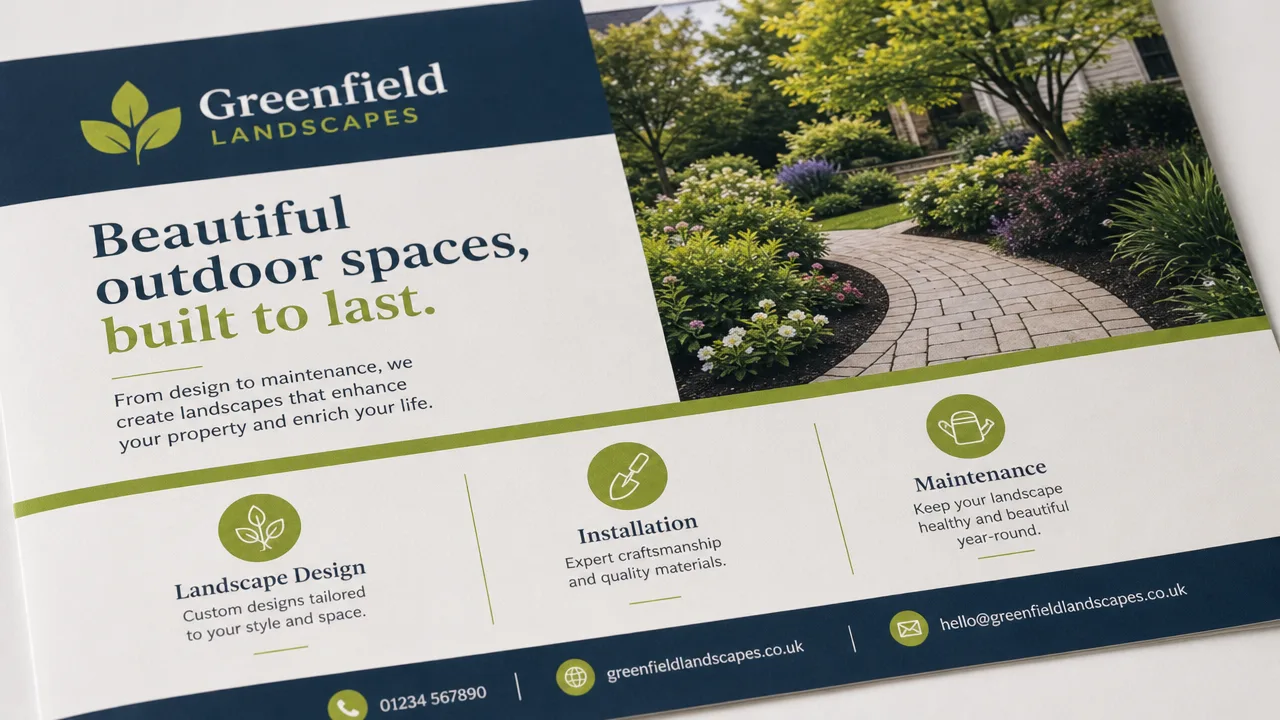
Door drop leaflets, printed in Keighley
Flyers and folded leaflets on litho and digital presses, with a choice of stocks and finishes, printed to your distributor's weight and packing spec.
Explore the serviceBooking and timing
- 1
Choose your channel
Book Royal Mail Door to Door through the Door to Door team or the Drop A Leaflet self-service site, or brief an independent distributor.
- 2
Pick areas and weeks
Drops are scheduled in weekly delivery windows. A Royal Mail contract can cover distributions over an 18-week period, and you can spread distribution and payments across it.
- 3
Confirm the spec before print
Agree the weight band, depth and handover packing with the distributor, then print to suit.
- 4
Print and hand over
Allow time for print and delivery to the distributor's depot before your first week. Royal Mail also offers a collection service.
- 5
Track and repeat
Measure response by area, drop the weak areas and repeat in the strong ones.
Allow for availability
Royal Mail prices are subject to availability, and busy weeks fill up. Book early for seasonal campaigns, and keep your offer dates loose enough to cover the whole delivery window.
Creative that works through the letterbox
- One clear offer, visible in the first second, on both sides (you don't know which way up it will land).
- A local hook: the town or area name, a map, or the nearest branch.
- A reason to act now, such as a dated offer or limited places.
- A single, simple response route: a short URL, a phone number or a QR code.
- A unique code or landing page for this drop so you can measure it.
- Something worth keeping, such as a menu, a timetable or a voucher. Door drops already stay in the home for about six days.
For more inspiration, see our direct mail ideas and examples.
Measuring door drop response
0.3%
average door drop response rate
Source: JICMAIL Response Rate Tracker
£4.00
average return per £1 spent
Source: JICMAIL Response Rate Tracker
87%
more likely to prompt a website visit when a door drop carries a QR code
Source: JICMAIL, Q2 2026
- Unique codes and URLs: give each drop, or each group of areas, its own voucher code, short URL or QR code.
- Postcode matchback: compare new customers' postcodes against the areas you dropped, over a set period after delivery.
- Control areas: compare sales in dropped areas with similar undropped ones to see the true uplift, including people who never used the code.
- Cost per response: divide total cost (print plus distribution) by responses, then compare areas and repeat in the best.
Benchmarks are averages; your own results matter more. Read more in our guide to direct mail response rates and ROI.
Opt-outs and compliance
Door drops don't use a named list, so the data rules for addressed mail don't apply in the same way. Households can still opt out. Royal Mail runs a Door to Door opt-out for unaddressed mail delivered by the post person, and the DMA's Your Choice scheme asks member distributors to stop delivering unaddressed items. Your Choice requests can take up to 12 weeks to reach member companies. Respect 'no junk mail' signs, and keep your claims and offer terms accurate.
Sources
- Royal Mail – Price Guide, April 2026 (Door to Door rate card, archived copy)
- Royal Mail – Door to Door User Guide (postcode sector bookings)
- Royal Mail – Drop A Leaflet self-service booking
- Royal Mail Marketreach – Door drops
- JICMAIL – Q2 2026 quarterly results
- JICMAIL – Response Rate Tracker, full year 2025 update
- DMA – Door drop standards
- Mailing Preference Service – Your Choice preference scheme