Quick answer
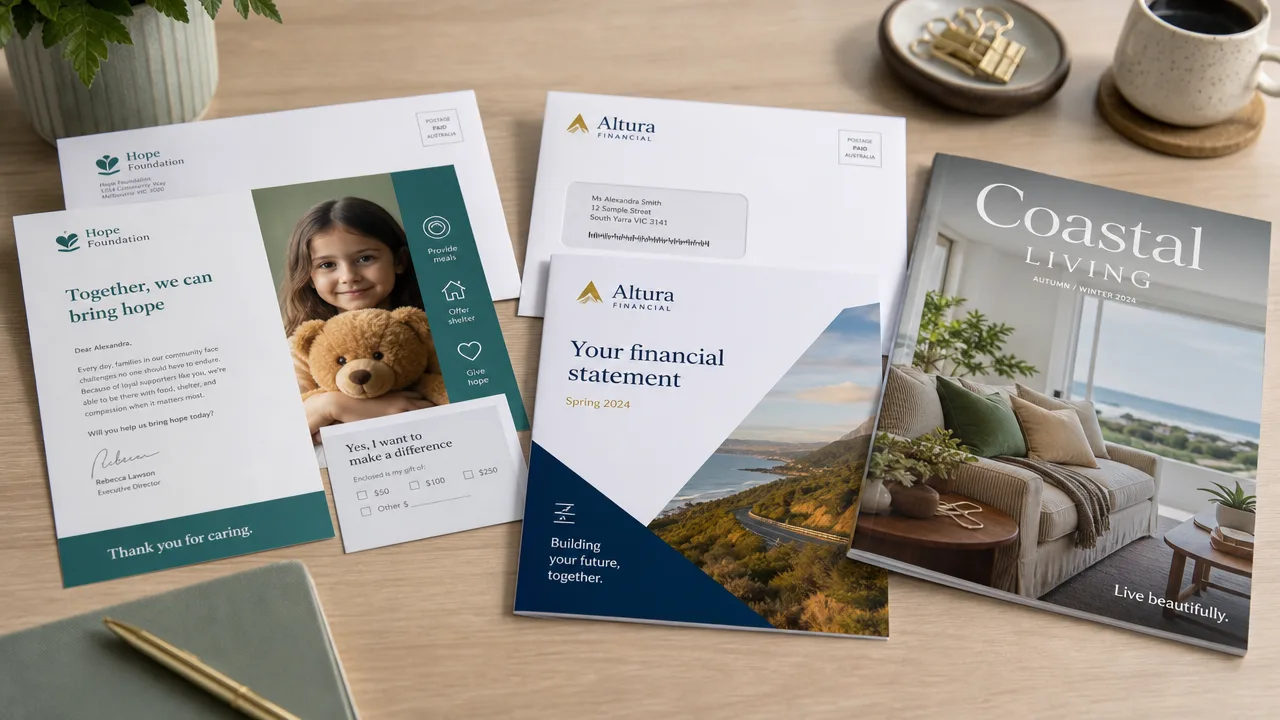
The cost of a UK direct mail campaign is made up of print and personalisation, data processing, enclosing and postage. Postage is usually the biggest single cost, and it depends heavily on how the mail is sent. On Royal Mail's April 2026 rate card, a standard Advertising Mail letter costs 74.0p unsorted, 42.9p–44.8p with Mailmark (unsorted, 1,000+ items) and as little as 29.0p–30.4p on Economy Low Sort (4,000+ items). Compare that with a 91p second class stamp. Print costs vary widely with format and quantity, so ask for a quote against your specification.
Key takeaways
- Budget for four elements: print, data, enclosing and postage.
- Using business postage rather than stamps makes a big difference. For 10,000 letters, second class stamps would cost £9,100. Advertising Mail Economy Low Sort Mailmark would be £3,040 (April 2026 prices, excluding VAT and levies).
- Sorting and barcoding mail to Mailmark standard, and reaching volume thresholds (1,000 for unsorted, 4,000 for low sort), cuts the postage rate.
- Format decides the postage band. Keeping a pack within the letter size and weight limits avoids large letter prices.
- Clean data reduces cost directly: every duplicate or goneaway removed is one less item printed and posted.
What makes up the cost of direct mail?
| Cost element | What it covers | What drives the price |
|---|---|---|
| Print and personalisation | Letters, envelopes, inserts, postcards or catalogues, plus variable data printing | Format, paper, number of colours and pages, finishes, quantity, and how much changes per item |
| Data processing | Address validation (PAF), de-duplication, suppression and personalisation set-up | Size and condition of the file, number of sources and the level of personalisation |
| Enclosing and finishing | Folding, inserting, matching personalised items and sealing | Number of components, whether items must be matched, and pack size |
| Postage | Royal Mail (or An Post for Ireland) delivery | Service (Advertising or Business Mail), class, sortation level, volume, size and weight |
Because print costs depend so much on specification and quantity, no single 'price per item' applies to every campaign. Postage, however, follows published tariffs, and it is where the biggest savings usually come from.
Royal Mail postage prices for direct mail (2026)
Royal Mail offers Advertising Mail for marketing mailings and Business Mail for other business communications such as statements and letters. Advertising Mail is considerably cheaper but has eligibility rules. The prices below are per letter (up to 100g) from Royal Mail's retail price guide effective 7 April 2026, excluding VAT and industry levies.
| Service (letter, up to 100g) | Price per item | Minimum volume |
|---|---|---|
| 2nd class stamp | 91p | None |
| Business Mail 2nd Class Mailmark Unsorted | 69.5p–88.0p (by volume) | None |
| Advertising Mail 2nd Class Standard Unsorted | 74.0p | None |
| Advertising Mail 2nd Class Mailmark Unsorted | 44.8p (1,000–2,499) to 42.9p (10,000+) | 1,000 items |
| Advertising Mail 2nd Class Low Sort Mailmark | 39.0p to 37.2p (80,000+) | 4,000 items |
| Advertising Mail Economy Low Sort Mailmark | 30.4p to 29.0p (80,000+) | 4,000 items |
£9,100
Postage for 10,000 letters using 2nd class stamps (91p each)
Source: Royal Mail, April 2026
£3,040
Postage for 10,000 letters on Advertising Mail Economy Low Sort Mailmark (30.4p each)
Source: Royal Mail, April 2026
Prices change regularly
Royal Mail changed some Advertising Mail prices on 5 January 2026 and others on 7 April 2026, and access prices for mailing houses are also changing. The figures here are a guide to the relative cost of each service. Your quote will use the tariffs in force on your posting date.
How size and weight affect postage
Royal Mail prices depend on the format band your item falls into. Designing a pack to stay within the letter band is one of the simplest ways to control cost.
| Format | Maximum size | Maximum weight |
|---|---|---|
| Letter | 240mm × 165mm × 5mm | 100g |
| Large letter | 353mm × 250mm × 25mm | 750g |
As a guide, a C5 or DL envelope holding a folded A4 letter and a couple of inserts usually fits within the letter band. A C4 envelope, a thick catalogue or a dimensional pack will be a large letter or larger. For comparison, Advertising Mail 2nd Class Mailmark Unsorted large letters (up to 100g) were 85.5p–89.2p on the April 2026 rate card, roughly double the letter price.
Tip
Check paper weight before you sign off a design. Moving from a heavy board to a lighter stock, or removing one insert, can be enough to stay under a weight step.
Seven ways to reduce the cost of direct mail
- 1
Use Mailmark sortation
Sorting and barcoding mail to Royal Mail's Mailmark standard unlocks the lower tariffs above. In our experience it often cuts postage by 15–30% compared with unsorted mail, and discounts typically become available from around 5,000 items.
- 2
Choose Advertising Mail where eligible
For marketing content, Advertising Mail is much cheaper than Business Mail. We will check your pack against Royal Mail's eligibility rules.
- 3
Allow more time with Economy
If your drop date has some flexibility, Economy services cost less than 2nd Class.
- 4
Clean your data
Validating addresses and removing duplicates and goneaways means you only pay for mail that can be delivered. See our data processing service.
- 5
Target better, not wider
Warm audiences respond at around six times the rate of cold ones (6.3% against 1%, JICMAIL). Mailing fewer, better-chosen people often lowers cost per response.
- 6
Design to the band
Keep packs within letter size and weight where the message allows, and talk to us before the design is final.
- 7
Look at Royal Mail incentives
Royal Mail runs incentives such as the First Time User and Test and Innovate schemes, which can earn postage credits for qualifying mailings, typically from 4,000 Advertising Mail items. Terms change, so ask us to check what applies.
Mailmark sortation and postage management
As a Mailmark accredited mailing house, we sort, barcode and submit your mailing so it qualifies for the lowest available tariff.
Explore the serviceLook at cost per response, not just cost per item
A cheaper pack is not always better value. JICMAIL's Response Rate Tracker found that A4 mailers achieve 2.7 times the response rate of postcards. If the larger format costs less than 2.7 times as much in total, it may deliver responses more cheaply.
For example, in a 500,000-record financial services acquisition mailing we produced, Mailmark sortation saved £18,000 in postage compared with standard Royal Mail tariffs, and the campaign delivered a 3.8x ROI within 90 days. Read the case study.
For more on what to expect from a mailing, read our guide to direct mail response rates and ROI.
Mailing the Republic of Ireland
Mail to the Republic of Ireland sent through standard UK international services is expensive. Handing it to An Post through a specialist route can cut the cost significantly. In one campaign for a UK retailer we cut cross-border postage by 41% compared with standard Royal Mail international rates. See our Ireland direct mail service and PostAim explained.
Sources
- Royal Mail – Retail Letters Price Guide, prices effective 7 April 2026 (archived copy)
- Royal Mail – UK stamp prices from 7 April 2026 (archived copy)
- Royal Mail – 2026 price changes (archived copy)
- Royal Mail – Business mail incentives (archived copy)
- JICMAIL – Response Rate Tracker, full year 2025 update