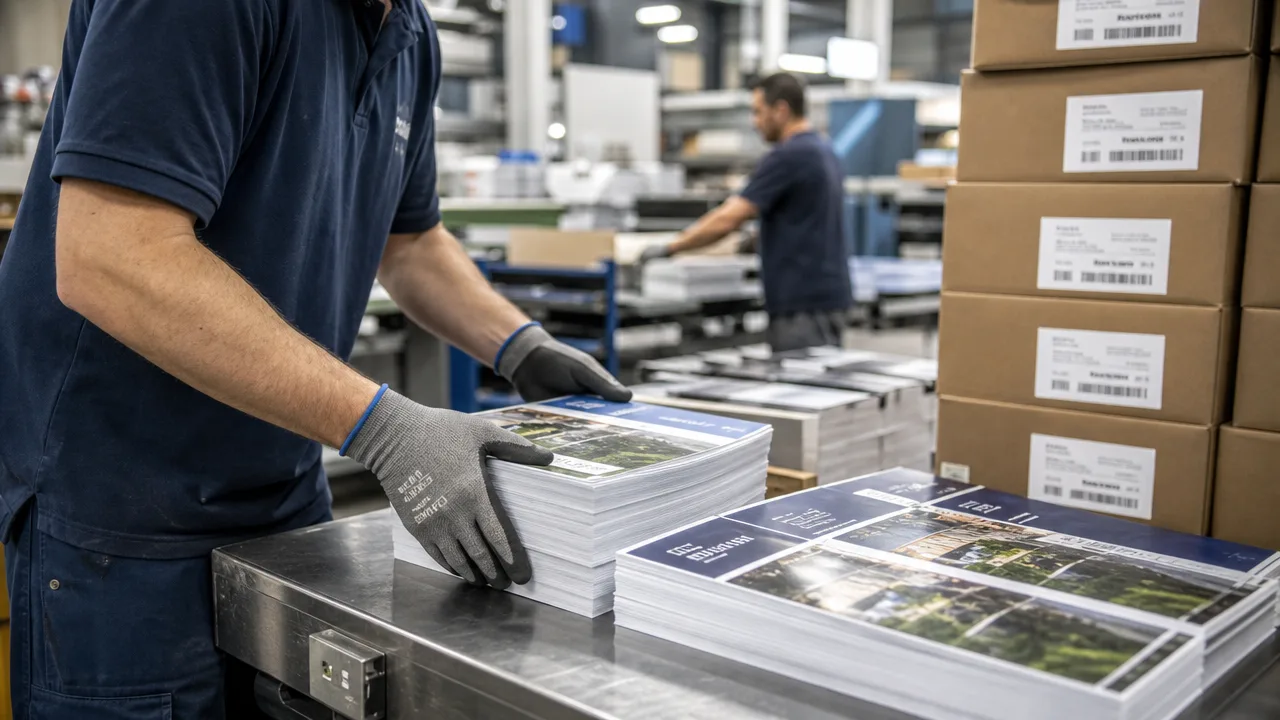
Quick answer
To plan a direct mail campaign, set a measurable goal, choose and clean your audience data, pick a format that suits the message, write creative around one clear call to action, agree print and postage with your mailing house, then track every response so you can improve the next mailing. Allow time for data checks and proofs. Once artwork and data are approved, production and handover to Royal Mail typically takes 5–10 working days.
Key takeaways
- Begin with the objective and the audience. Format and creative follow from them.
- Warm audiences (customers, donors, members) respond at several times the rate of cold prospects: 6.3% against 1% in JICMAIL's Response Rate Tracker.
- Data quality is the cheapest way to improve results. Validate, de-duplicate and suppress before you print.
- Involve your mailing house before artwork is final. Pack size, weight and enclosing affect both cost and timing.
- Build in a test and a way to measure it, so each campaign makes the next one better.
The eight steps at a glance
- 1
Set the objective and budget
Decide what you want people to do and what a response is worth to you.
- 2
Choose your audience
Existing customers or supporters, lapsed contacts or new prospects.
- 3
Prepare and clean the data
Validate addresses, remove duplicates and suppress people who should not be mailed.
- 4
Pick a format
Letter pack, postcard, self-mailer, catalogue or a multi-item pack.
- 5
Write the offer and creative
One message, one call to action, easy ways to respond.
- 6
Plan the test
Change one thing at a time and keep the test cells large enough to read.
- 7
Produce and post
Proofs, print, personalisation, enclosing, sortation and handover to Royal Mail.
- 8
Measure and follow up
Track responses, match back to the mailing file and plan the next contact.
Step 1: Set the objective and budget
Write the objective as a number: 400 new customers, £50,000 in donations, 1,500 renewals. Then work backwards. If you know the average value of a response, you can set a maximum cost per response and judge the campaign against it, rather than against a response rate taken out of context.
Your budget should cover four elements: print and personalisation, data processing, enclosing and finishing, and postage. Postage is often the largest single cost, so choose the postage service early. Our guide to direct mail costs in the UK explains each element.
Step 2: Choose your audience
The audience has more influence on results than any creative decision. JICMAIL's Response Rate Tracker, based on 4,939 UK campaigns, gives a clear picture:
| Audience | Average response rate | Average ROI per £1 |
|---|---|---|
| Warm direct mail (existing relationship) | 6.3% | £8.80 |
| Cold direct mail (prospects) | 1.0% | £2.10 |
Most organisations get the best return by mailing their own customers or supporters first, then using what they learn to choose the right prospect lists. Segment your file by recency, frequency and value, and give the best segments the most personal treatment.
Step 3: Prepare and clean the data
Before anything is printed, your data should be:
- Validated against Royal Mail's Postcode Address File (PAF), so addresses are complete and deliverable.
- De-duplicated, so nobody receives two packs.
- Suppressed against goneaway, deceased and opt-out records, and against people who have asked not to receive postal marketing from you.
- Lawful: record your lawful basis under UK GDPR. Postal marketing is not covered by PECR, and legitimate interests is often appropriate if you complete an assessment and offer an easy opt-out.
We hold ISO/IEC 27001 certification and handle all of this in-house. See our data processing service.
Step 4: Pick the right format
| Format | Best for | Things to consider |
|---|---|---|
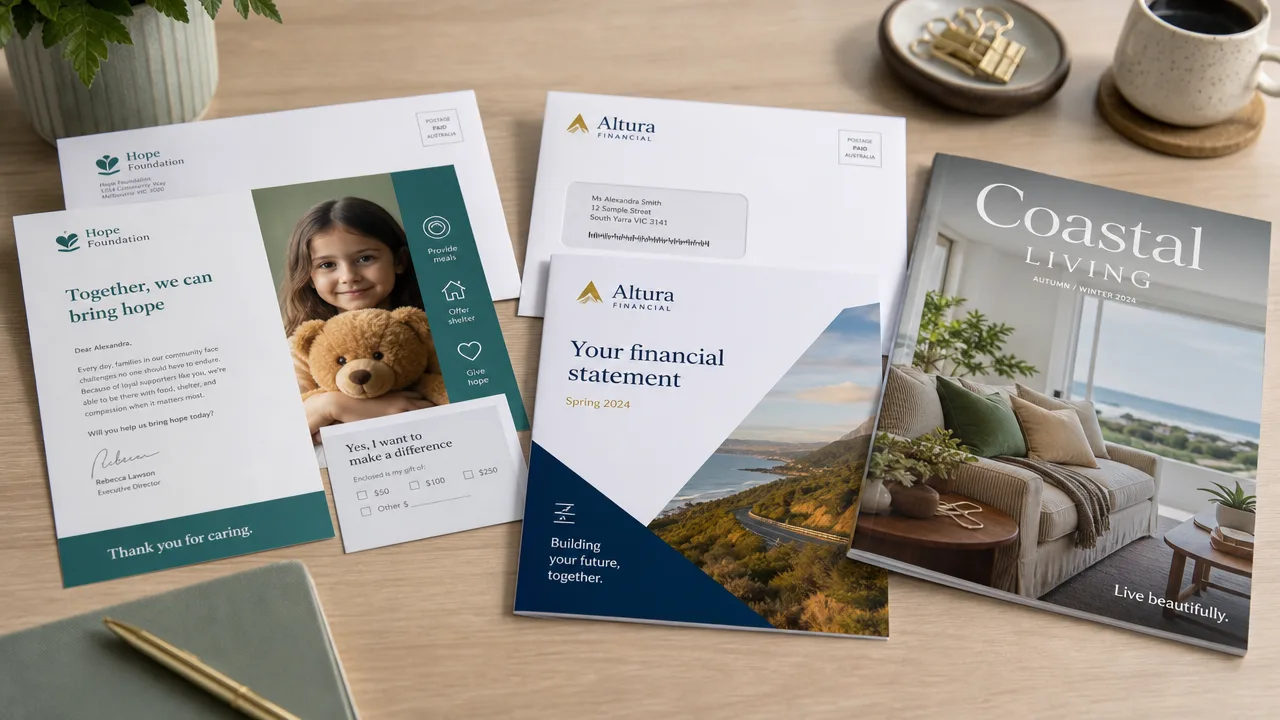
| Letter pack (envelope, letter, inserts) | Fundraising appeals, financial services, detailed or personal messages | More components to print and enclose. The most room to explain and personalise. |
| Postcard | Simple reminders, events, short offers | Low print cost and no envelope, but limited space and no privacy. |
| Self-mailer | Promotions with more content than a postcard | Folded and sealed without an envelope. Check the fold and seal suit Royal Mail machinery. |
| Catalogue or brochure | Retail, B2B ranges, membership packs | Higher print cost per item, but a long life in the home. |
| Dimensional or multi-item pack | High-value prospects, samples, launches | Stands out, but check the size and weight bands carefully. |
Size matters as well as type. JICMAIL's Response Rate Tracker found that A4 mailers achieve 2.7 times the response rate of postcards. Bigger is not always better value, though, so weigh the response against the extra cost. Always check the finished size and weight against Royal Mail's letter and large letter bands.
Step 5: Write the offer and creative
- Lead with the benefit to the reader, not the product.
- Make one clear request and repeat it on every component.
- Personalise beyond the name where data allows: last purchase, nearest store, last gift amount.
- Make responding easy with a QR code, short URL, phone number or reply envelope. JICMAIL found that direct mail containing a QR code was 60% more likely than the average mail item to prompt a website visit.
- Give a reason to act now, such as a deadline, limited availability or a seasonal hook.
For inspiration, see our direct mail ideas and examples.
Step 6: Plan a test
Every campaign is a chance to learn. Split the file into random cells and change one variable per cell: the offer, the format, the opening line or the envelope message. Keep a control version that matches your previous best performer.
Tip
Make each test cell large enough to show a real difference. A cell that produces only a handful of responses cannot tell you much. If your volumes are small, test bigger changes, such as a different offer or format, rather than small wording tweaks.
Step 7: Produce, enclose and post
A typical production timeline with Fretwell looks like this:
| Stage | What happens | Typical timing |
|---|---|---|
| Brief and quote | Format, quantities, data and postage confirmed | Before artwork is final |
| Data processing | PAF validation, de-duplication, suppression, personalisation fields | Alongside artwork |
| Proofs | Print and variable data proofs signed off | Depends on how quickly proofs are approved |
| Print, enclose and sort | Printing, personalisation, matched enclosing, Mailmark sortation | 5–10 working days from approved artwork and data |
| Handover | Submitted to Royal Mail (or An Post for the Republic of Ireland) | On the agreed drop date |
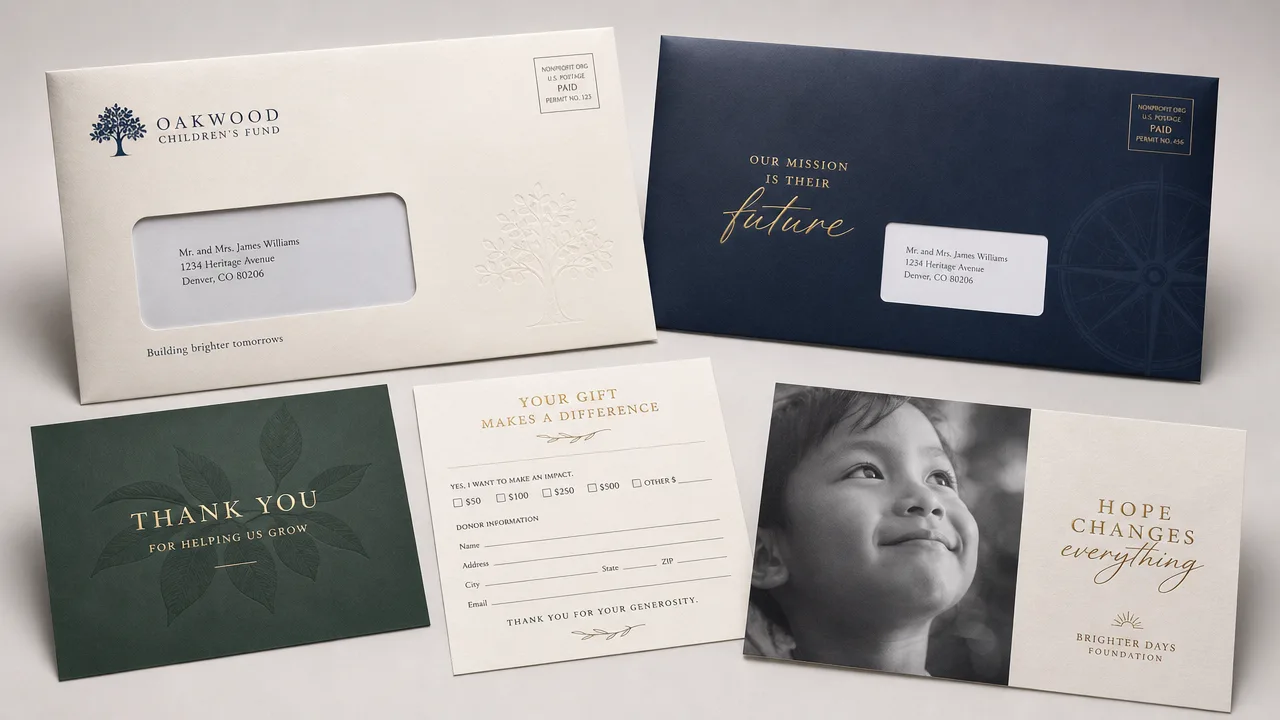
One supplier from data to doormat
Print, personalisation, camera-matched enclosing and Mailmark sortation, all at our Keighley site.
Explore the serviceStep 8: Measure and follow up
- Track coded responses by test cell, and also match sales or donations back against the mailing file, because many people respond without using a code.
- Compare results against your target cost per response, not just the response rate.
- Follow up: a reminder email for opted-in recipients, a second wave to non-responders, or a phone call to high-value contacts.
- Record what you learned and roll the winning version into your next control.
Ready to start? Work through our direct mail campaign checklist before you sign off.