Quick answer
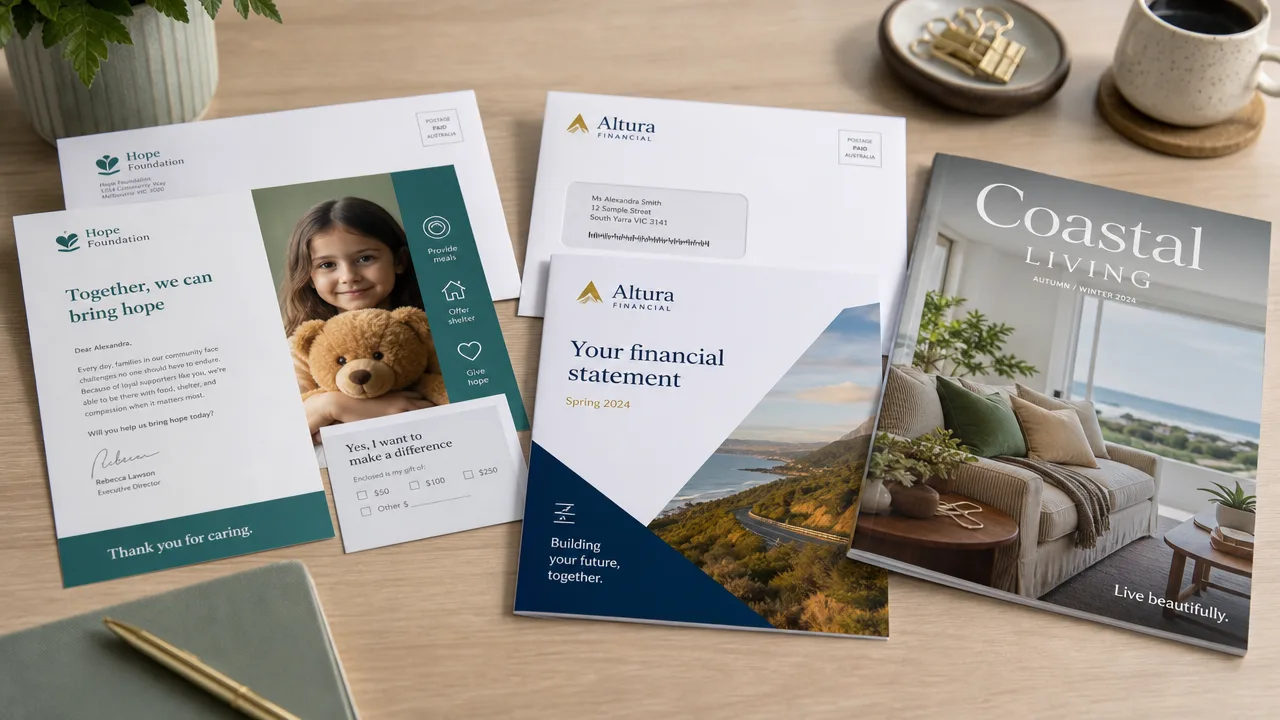
Direct mail marketing means sending printed marketing, such as letters, postcards, catalogues and leaflets, through the post to existing or potential customers. Royal Mail Marketreach defines direct mail as "addressed mail sent to existing or potential new customers", while partially addressed mail and door drops reach households without a named recipient. In the UK, a direct mail item is kept in the home for 7.4 days and interacted with 4.4 times on average (JICMAIL, Q2 2026). That lasting attention is why mail remains a core channel for charities, retailers, financial services and B2B brands.
Key takeaways
- Direct mail includes addressed mail (to a named person), partially addressed mail (to households selected by postcode data) and door drops (unaddressed leaflets).
- Mail gets lasting attention: 7.4 days in the home, 4.4 interactions and 151 seconds of attention per direct mail item (JICMAIL, Q2 2026).
- Measured UK campaigns average a 6.3% response for warm mail and 1% for cold mail (JICMAIL Response Rate Tracker).
- Postal marketing is not covered by PECR, but UK GDPR applies. Many organisations use legitimate interests and screen against the Mailing Preference Service.
- Costs are print, data, enclosing and postage. Sorted Mailmark mail can cost under half the price of a stamp.
What is direct mail marketing?
Direct mail is any marketing sent through the post directly to a person or household: a fundraising appeal, a catalogue, a welcome pack, a renewal reminder, a postcard announcing a sale. Unlike broadcast advertising, it can be targeted precisely and personalised for each recipient. And because it is physical, it stays around long after a digital message has been scrolled past.
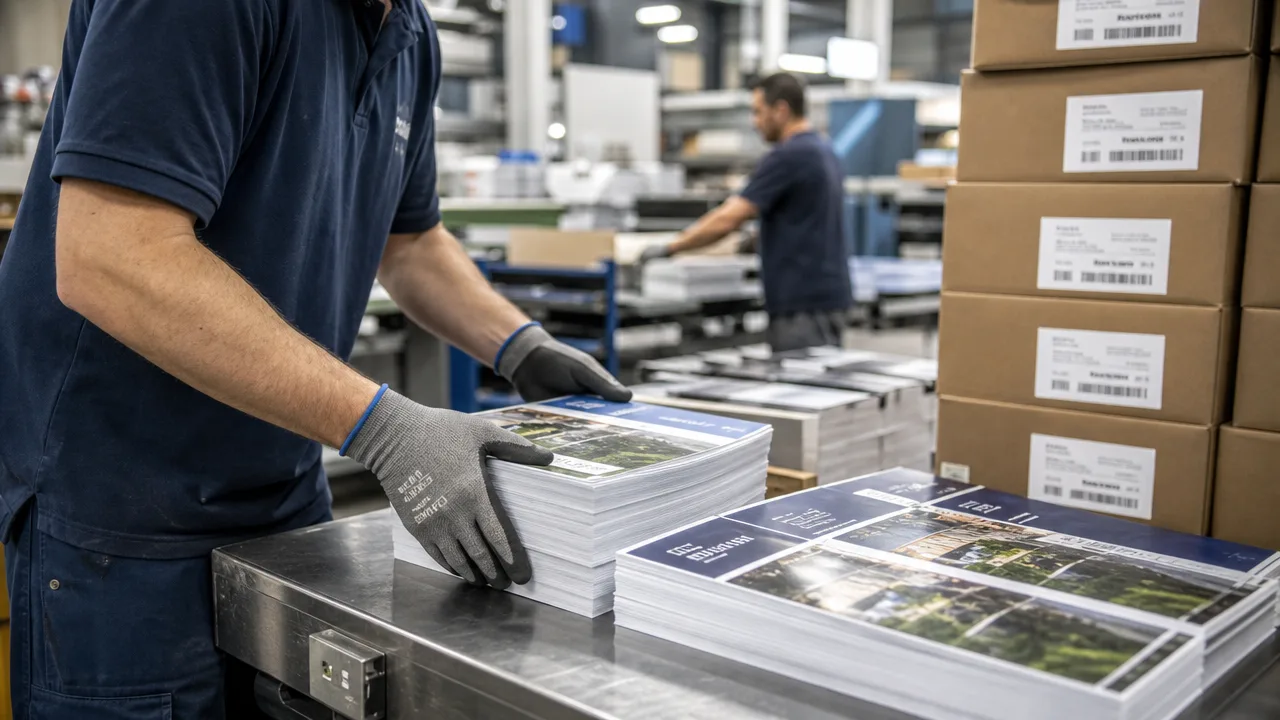
A typical campaign combines a mailing list (your own customers or a compliant prospect list), a printed pack designed to prompt an action, and a postage service to deliver it. A mailing house like Fretwell brings these together: cleaning the data, printing and personalising the pack, enclosing it and handing it to Royal Mail at the lowest available tariff.
Types of direct mail
| Type | How it is addressed | Typical use |
|---|---|---|
| Addressed direct mail | To a named person at a specific address | Customer and supporter marketing, acquisition from prospect lists, appeals |
| Partially addressed mail | To 'the resident' at addresses chosen using postcode data, in groups of around 15 households | Reaching look-alike neighbourhoods without a named list |
| Door drops | Unaddressed, delivered to every household in chosen areas | Local promotions, store openings, broad acquisition |
| Catalogues | Usually addressed | Retail and B2B product ranges |
| Business mail | Addressed | Statements, notices and service letters that may carry marketing messages |
Royal Mail prices marketing mailings as Advertising Mail, which is cheaper than standard Business Mail but has eligibility rules. Our cost guide compares the tariffs.
Why direct mail works
7.4 days
Average lifespan of a direct mail item in the home
Source: JICMAIL, Q2 2026
151 sec
Average attention per direct mail item
Source: JICMAIL, Q2 2026
71%
Consumers who say they completely trust the mail they receive
Source: Royal Mail Marketreach
27%
How much more likely campaigns including mail were to deliver top-ranking sales performance
Source: IPA Databank via Royal Mail Marketreach
- It is physical. People hold it, keep it, put it on the side and pick it up again. Each item is interacted with 4.4 times on average.
- It is trusted. Royal Mail Marketreach research found consumers are twice as likely to agree as disagree that they pay more attention to mail than to email.
- It is targeted. You choose exactly who receives it, and you can personalise every item.
- It drives action online and offline. 9.5% of mail items prompted a website visit in Q2 2026, and 41% of mail-driven purchases were made in-store.
- It boosts other channels. Research for Marketreach found people who had seen mail looked at a social advert from the same brand for 30% longer.
How a direct mail campaign works
- 1
Brief
Agree the objective, audience, budget and timing.
- 2
Data
Validate addresses against the Postcode Address File, remove duplicates and suppress goneaways, deceased records and opt-outs.
- 3
Creative and format
Design a pack around one clear call to action, within Royal Mail size and weight limits.
- 4
Print and personalise
Print the pack, with names, offers, codes and images personalised on every item where needed.
- 5
Enclose and sort
Fold, insert and match items, then sort and barcode to Mailmark standard.
- 6
Post and measure
Hand over to Royal Mail, then track responses and match sales back to the mailing file.
Our step-by-step planning guide explains each stage in detail, and our campaign checklist helps you make sure nothing is missed.
What results can you expect?
| Mail type | Average response rate | Average ROI per £1 |
|---|---|---|
| Warm direct mail | 6.3% | £8.80 |
| Cold direct mail | 1.0% | £2.10 |
| Partially addressed mail | 0.7% | £2.30 |
| Door drops | 0.3% | £4.00 |
Results vary widely by sector, audience and format: warm charity appeals average 11.5%, for example. Read more in our guide to direct mail response rates and ROI, or get inspiration from our direct mail ideas and examples.
How much does direct mail cost?
The cost per item depends on format, quantity and postage service. Postage is usually the biggest element. On Royal Mail's April 2026 rate card, Advertising Mail letters range from 74.0p unsorted to 29.0p–30.4p on Economy Low Sort Mailmark (4,000+ items), compared with a 91p second class stamp. Print, data processing and enclosing are added on top.
See the full breakdown and ways to save in how much does direct mail cost in the UK?

UK direct mail from one site
Data processing, print, personalisation, enclosing and Mailmark sortation, all in-house in Keighley.
Explore the serviceDirect mail and the law
- UK GDPR applies whenever you use personal data. You need a lawful basis. For postal marketing, many organisations rely on legitimate interests, supported by a documented assessment and a clear way to opt out.
- PECR does not cover post. The ICO confirms that direct marketing by post is not covered by the Privacy and Electronic Communications Regulations, which set the consent rules for email and text marketing.
- The Mailing Preference Service (MPS) is the free register, managed by the Data & Marketing Association (DMA), for people who do not want unsolicited personally addressed mail. Using it is not a legal requirement, but screening against it is a condition of the DMA Code for cold mailings.
- Sector rules may apply, for example financial promotion rules for regulated financial services.
Note
Data protection law is being updated following the Data (Use and Access) Act. Check current ICO guidance or take legal advice for your own circumstances. We are ICO registered and certified to ISO/IEC 27001 for information security.
Direct mail vs digital marketing
Mail costs more per contact than email or social media, but it gets more attention and lasts longer. It also reaches people who have not opted in to email. The strongest campaigns use both. For a full side-by-side comparison of cost, response, ROI and rules, read direct mail vs email marketing.
Who uses direct mail?
- Charities: appeals, raffles, Gift Aid and supporter care. Warm charity mail averages an 11.5% response. See charity print and mail.
- Financial services: acquisition, renewals and regulated communications. See financial services.
- Retail and e-commerce: catalogues, offers, win-back and abandoned basket mailings. See retail.
- Healthcare: appointment letters and patient communications. See healthcare.
- Agencies and printers: white-label mailing for their own clients. See trade print.
Getting started with direct mail
If you are new to mail, start with your warmest audience, such as recent customers, lapsed customers or active supporters, and a simple, well-tested format like a personalised letter pack. Mailmark discounts typically become available from around 5,000 items. Once artwork and data are approved, most campaigns are produced and handed to Royal Mail within 5–10 working days.
Mailing the Republic of Ireland too? See our Ireland direct mail service.
Sources
- Royal Mail Marketreach – Direct marketing
- Royal Mail Marketreach – Partially addressed mail
- JICMAIL – Q2 2026 quarterly results
- JICMAIL – Response Rate Tracker, full year 2025 update
- Royal Mail Marketreach – Build brand trust with mail
- Royal Mail Marketreach – The private life of mail
- Royal Mail Marketreach / WARC – Driving effectiveness with direct mail (2021)
- Royal Mail – Retail Letters Price Guide, April 2026 (archived copy)
- ICO – Plan your direct marketing
- DMA – Preference services (TPS and MPS)
- DMA Code of Practice