Quick answer
Retail direct mail covers the printed pieces retailers post to customers and prospects: catalogues, seasonal offer mailers, loyalty and points mailings, and triggered mail such as welcome, birthday, win-back and abandoned basket pieces. It works best when it uses the purchase data you already hold. JICMAIL's tracker puts the average response to warm retail mail (sent to existing customers) at 3.7%, against 0.8% for cold retail mail. For acquisition, retailers often add partially addressed mail or door drops, which target areas rather than named people. Each piece should carry a unique code or QR code so sales can be traced back to the mailing.
Key takeaways
- Mail your existing customers first: JICMAIL reports 3.7% average response for warm retail mail against 0.8% for cold (2022–2025 average).
- Catalogues still prompt action. In research for Royal Mail Marketreach, 55% of consumers said they had bought something they saw in a catalogue in the past year.
- Triggered mail (birthday, lapsed, abandoned basket) turns e-commerce data into timely print. It needs a regular data feed and suppression rules agreed up front.
- Format matters: in warm retail mail, JICMAIL found A4 mailers averaged 9.6% response, A5 6.6% and postcards 3.5%.
- Give every piece a unique voucher code, URL or QR code so you can measure sales by segment and version.
What retail direct mail includes
Retailers use mail at every stage of the customer relationship. The table below shows the main types, who they go to and the data each one depends on. Most retail programmes combine several: a seasonal catalogue to the whole customer file, triggered pieces for individual moments, and an acquisition mailing to new households.
| Type | Who receives it | Data needed | Typical format |
|---|---|---|---|
| Catalogue | Existing customers, lapsed customers, prospects | Customer file; recency and value segments | A4 or A5 saddle-stitched or PUR-bound book |
| Seasonal offer mailer | Customers in chosen segments | Purchase history, location | Letter, folded leaflet or self-mailer |
| Loyalty and points mailing | Loyalty scheme members | Points balance, tier, preferences | Personalised letter or statement with vouchers |
| Triggered mail | Individuals after an event (birthday, lapse, abandoned basket) | A regular feed of event data from your platform | Postcard, letter or self-mailer |
| Order inserts | Customers receiving an e-commerce order | Order data, if versioned | Leaflet or card in the parcel |
| Acquisition mailing | New households that look like your customers | Postcode or area targeting rather than names | Partially addressed mail or door drop |
Warm mail does most of the work. JICMAIL's Response Rate Tracker puts the average response to warm retail and online retail mail at 3.7%, against 0.8% for cold mail (2022–2025 average). See direct mail response rates for the full sector table.
Catalogues: format, pages and postage
A catalogue is still one of the strongest pieces of retail print. In research commissioned by Royal Mail Marketreach and published with Retail Week, 76% of consumers said catalogues or product brochures give them ideas for things to buy, and 55% had bought something they saw in a catalogue in the past year. The same survey found 60% felt they received too many marketing emails, against 42% for marketing through the post.
- Format: A4 portrait suits a large range with product detail. A5 is more portable and lighter to post. Landscape layouts give wide photography room.
- Pages and binding: saddle-stitched catalogues are planned in multiples of four pages. Thicker catalogues often move to a PUR-bound square spine. See binding methods for the trade-offs.
- Paper: coated silk or gloss shows product photography best, and a heavier cover protects the book in the post. See silk vs gloss vs uncoated paper and paper weight and GSM.
- Postage format: an A4 catalogue posted flat in a C4 envelope is a Royal Mail Large Letter (up to 353 × 250mm, 25mm thick and 750g). An A5 catalogue in a C5 envelope can stay a Letter only if the pack is within 5mm and 100g. See envelope sizes.
- Versions: different covers, a personalised letter or a version for lapsed customers can be produced in the same run. Tell us which pages are common and which change.
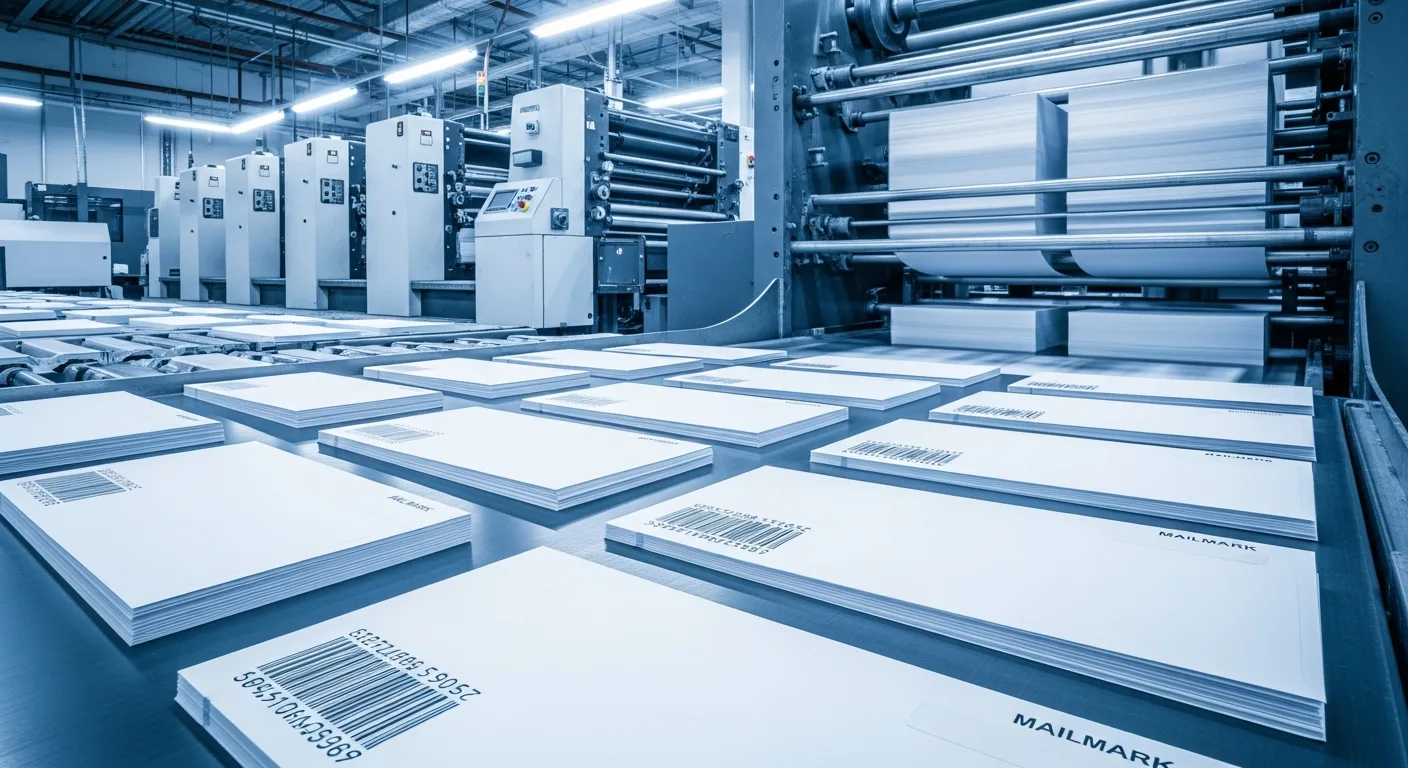
Our B2 Heidelberg litho presses handle catalogue runs from 5,000 to several million copies. Pre-press, printing, folding, stitching and mailing all happen at our Keighley site, so the catalogue is printed, enclosed and sorted for Royal Mail Mailmark in one place.

Catalogues printed, bound and mailed in one place
Litho and digital catalogue printing with binding, personalised covering letters, enclosing and Mailmark sortation at our Keighley site.
Explore the serviceLoyalty and triggered mail
Loyalty mailings and triggered pieces use data about individual customers, so every item is different. Variable data printing changes the name, offer, product images, points balance and voucher code on each piece from your data file. See variable data printing for how it works and how personalised jobs are proofed.
- 1
Choose the trigger
Common triggers are a welcome after first purchase, a birthday, a points milestone, a lapse in buying, or an abandoned basket. Start with one or two you can measure.
- 2
Agree the data feed
Triggered mail runs from a regular data file, usually a secure SFTP drop or an API connection from your e-commerce platform. Agree the fields, the file schedule and who owns each one.
- 3
Set suppression rules
Exclude customers who have opted out of mail and anyone who has received a mailing within a set window. This is built into the workflow, not checked by hand.
- 4
Design for variation
Design one template with spaces for the variable name, offer, images and code. Proof it with real examples of short, long and unusual data.
- 5
Produce and post on a schedule
Each file is processed, printed, enclosed and handed to Royal Mail within an agreed service window, then reported back.
- 6
Measure against a control
Hold back a random group who do not receive the mailing, so you can see the sales the mail actually added.
Royal Mail Marketreach's case study on DASH Water shows the potential: the e-commerce drinks brand recorded an 8% conversion rate on abandoned basket mailings and a 168% increase in win-back conversion from data-triggered mail. More examples are in direct mail ideas and examples.
Data rules still apply
Postal marketing to existing customers usually relies on legitimate interests, and anyone who objects must be suppressed. See GDPR and direct mail and, for the data file itself, our mailing data template.
Reaching new customers
Mailing your own customers is the cheapest response you will get. To grow, retailers usually add one of three acquisition routes:
| Route | How it targets | Best for |
|---|---|---|
| Partially addressed mail | Postcodes chosen from your best customers' profile, addressed to 'The Resident' | Retailers with a customer file to model from |
| Door drops | Whole postcode sectors or areas around stores | Store openings, local offers and broad reach |
| Rented lists | Named people from a list broker, screened and suppressed | Specific audiences a broker can supply legally |
Read partially addressed mail, door drop marketing and how to rent or buy a mailing list for the details, or compare them side by side in addressed vs partially addressed vs door drops.
Planning the year and measuring results
Retail mail follows the retail calendar: January sales, Valentine's Day, Mother's Day, Easter, summer, back to school, Black Friday and Christmas. Work back from the date you want the mailing on the doormat, allowing for production, postage and delivery. Our free 2027 direct mail planning calendar has the key dates and space to plan each campaign.
QR codes help close the loop between print and online. JICMAIL found direct mail containing a QR code is 60% more likely to prompt a website visit than the average mail item (Q2 2026).