
Quick answer
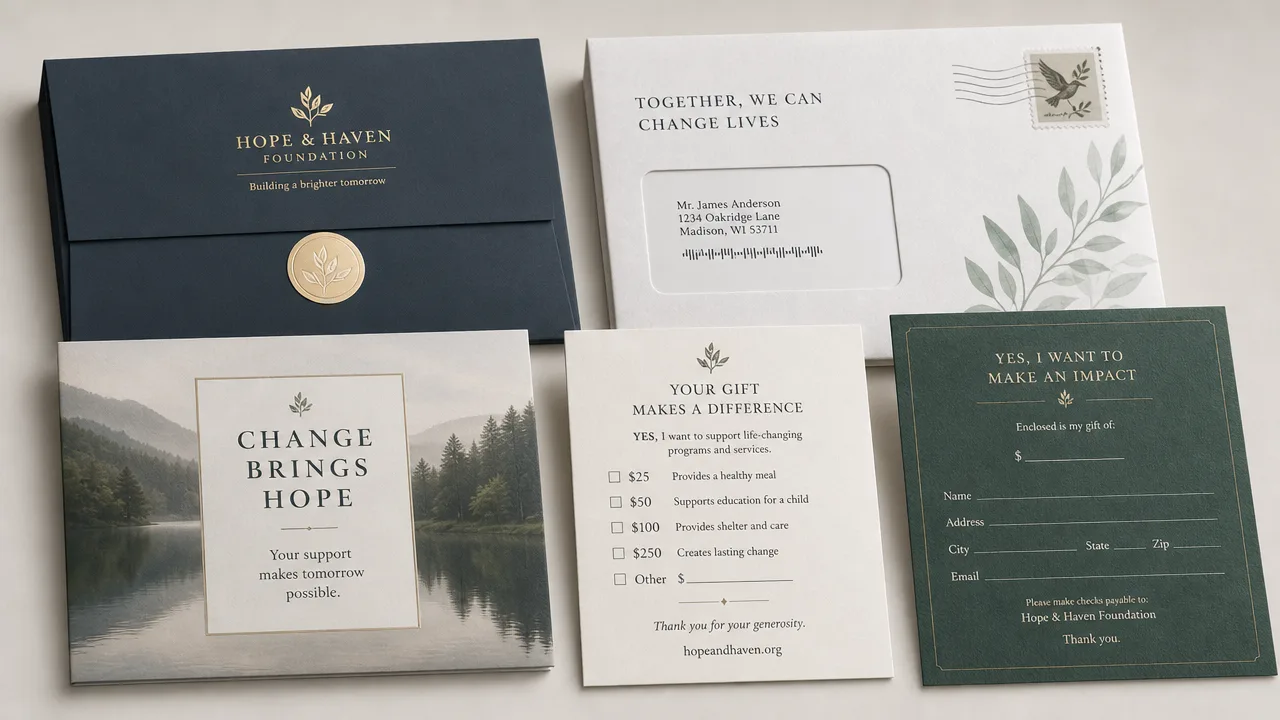
A charity appeal pack usually contains an outer envelope, a personalised appeal letter, a reply or donation form (often with a Gift Aid declaration), a reply envelope and sometimes an insert or premium such as a pen, coin or seed packet. Before it mails, check that the data is suppressed against the Fundraising Preference Service, MPS and your own opt-outs; that the pack states the charity is registered where the law requires it; that any Gift Aid declaration includes HMRC's required information; and that the finished pack fits the Royal Mail format you have budgeted for. Our free printable checklist covers every step.
Key takeaways
- Registered charities in England and Wales with gross income over £10,000 must state that they are registered on documents that ask for money or property (Charities Act 2011, section 39). Scottish charities must show their name and SC number.
- The Code of Fundraising Practice requires charities to check against the Fundraising Preference Service, MPS and TPS, stop contacting people known to have died, and offer a simple opt-out (standard 8.4).
- An FPS suppression request must be actioned within 21 days of notification, under the FPS terms and conditions.
- A Gift Aid declaration must give the donor's name and home address, name the charity, identify the gifts and confirm they are to be treated as Gift Aid. A signature is not required (HMRC chapter 3).
- Pre-printed appeal letters primarily seeking money, and envelopes over-printed with a related appeal, can be zero-rated for VAT with a declaration from the charity (VAT Notice 701/58).
Download the charity appeal pack checklist
Free download · PDF · 112 KB
Charity appeal pack checklist
A printable two-page A4 checklist covering every component, the data and suppression checks, the compliance points and the production sign-off for an appeal mailing.
Tick it off as the pack comes together, or share it with your agency and mailing house so everyone works to the same list. The sections below explain each check and where the rule comes from.
What goes in a charity appeal pack
| Component | Its job | Things to check |
|---|---|---|
| Outer envelope | Gets the pack opened | Teaser message; window position matches the address on the letter or form; over-printed with the appeal if you want VAT zero-rating on it |
| Appeal letter | Tells the story and makes the ask | Personalised name and ask amounts; accurate claims; registered charity statement; contact details and privacy information |
| Reply or donation form | Makes it easy to give | Pre-filled name, address and supporter number; ask amounts matching the letter; payment options; Gift Aid declaration; opt-out choice |
| Gift Aid declaration | Adds 25% to eligible gifts | HMRC's required information and an explanation of the donor's tax responsibility (see below) |
| Reply envelope | Returns the gift | Freepost or business reply licence and artwork; fits the form without folding it awkwardly |
| Insert or premium | Lifts response or engagement | Pen, coin, seed packet or similar; adds weight and thickness; must not encourage giving through guilt |
Not every appeal needs every component. A warm supporter mailing might be a letter and a reply form; a cold acquisition pack might add a premium to stand out. Whatever the mix, plan the components together, because the largest item sets the envelope and the total sets the postage.
Data, personalisation and suppression checks
Appeal data has to be both accurate and respectful. The Code of Fundraising Practice (standard 8.4.1) says you must not send fundraising communications to people who have said they do not want them, must stop sending them to people you know have died, and must check against the Fundraising Preference Service, the Mailing Preference Service and the Telephone Preference Service.
Ask-string personalisation is one of the most common charity jobs we run: our data team maps the last-gift and ask-string logic you specify and generates the variable data that prints on each letter and form. More on how this works in variable data printing.

Appeal packs printed, personalised and enclosed in one place
Ask-string personalisation, Gift Aid inserts, coin and pen enclosing and camera-matched packs, all at our Keighley site.
Explore the serviceCompliance checks for appeal materials
General guidance, not legal advice
This page summarises the main rules for UK charity appeal mailings. Check the current guidance from the Fundraising Regulator, the Charity Commission, OSCR and HMRC, or take advice, for your own campaign.
| Check | What the rule says | Source |
|---|---|---|
| Registered charity statement (England and Wales) | A registered charity with gross income over £10,000 in its last financial year must state that it is registered, in English and in legible characters, on notices, advertisements and other documents asking for money or property. | Charities Act 2011, section 39 |
| Scottish charities | Documents asking for donations must show the charity's registered name, its Scottish charity number (SC followed by a zero and five digits) and, if not clear from the name, that it is a charity. | OSCR guidance; Charities References in Documents (Scotland) Regulations 2007 |
| Accurate content | Information about the charity, its fundraising and how donations are used must be accurate and not misleading. | Code of Fundraising Practice, 8.1.3 |
| Enclosures | Enclosures must strengthen the message and must not encourage a donation based on guilt or embarrassment. | Code of Fundraising Practice, 8.1.6 |
| Contact and data information | Your contact details and information about how you process personal data must be easy to access. | Code of Fundraising Practice, 8.2.1 |
| Opt-out | Give people a simple way to tell you they do not want to receive messages from you. | Code of Fundraising Practice, 8.4.3 |
| No undue pressure | Take reasonable steps not to put undue pressure on people to donate or use unreasonably persistent approaches. | Code of Fundraising Practice, 1.1.2 |
Gift Aid declarations. HMRC's guidance (chapter 3.6) says a declaration must state the donor's name and home address, name the charity, identify the gift or gifts it covers and confirm they are to be treated as Gift Aid donations. It must not be in a company name or joint names. You must also explain the donor's tax position, including that they may have to pay any difference if they have not paid enough tax; 'I am a UK taxpayer' on its own is not enough. There is no requirement for a signature.
VAT on appeal print. HMRC's VAT Notice 701/58 allows zero-rating for pre-printed appeal letters whose primary purpose is to ask for money (a letter, not just a form), and for envelopes used with them if they are over-printed with a related appeal. The charity normally gives the supplier a declaration that the conditions are met. Ask us to check which items in your pack qualify.
Production and postage checks
Sources
- Fundraising Regulator – Code of Fundraising Practice, Fundraising communications and advertising (section 8)
- Fundraising Regulator – Code of Fundraising Practice, Behaviour when fundraising (section 1)
- Fundraising Regulator – Fundraising Preference Service: guidance for charities
- legislation.gov.uk – Charities Act 2011, section 39
- OSCR – Publicising that you are a charity
- HMRC – Charities: detailed guidance notes, chapter 3 Gift Aid
- HMRC – VAT Notice 701/58: charity advertising and goods connected with collecting donations
- Royal Mail – Price Guide, April 2026 (Know your formats)