Quick answer
Trade print (also called white-label print) is print and mail produced by one company and sold on by another under its own name. Designers, agencies, print managers, brokers and other printers use trade printers to offer work they cannot produce themselves, without the end client ever seeing the producer. A good UK trade printer despatches in plain packaging with your reference on delivery notes and labels, signs an NDA before any work starts, and never approaches your clients. It should also have the presses, finishing and mailing capacity to take your biggest jobs, quote quickly and hold certifications such as ISO 9001 and ISO 27001 that you can show your own clients.
Key takeaways
- Trade print lets you sell print and mail you don't produce yourself, under your own brand, without the fixed cost of owning equipment.
- Confidentiality is the core of the service: plain packaging, your reference on paperwork, unmarked delivery vans and a signed NDA.
- Check capability, not just price: presses, in-house finishing, data processing and mailing decide which jobs you can take on.
- If a job involves your client's personal data, your trade printer is a sub-processor, and the data protection contract has to reflect that.
- Clear briefs and print-ready files are what keep trade margins safe. A brief template and a pre-flight checklist prevent most re-quotes and reprints.
What trade print is and who uses it
In a trade arrangement there are three parties: the end client who needs the print, the reseller who sells it to them, and the trade printer who produces it. The end client deals only with the reseller. The trade printer works to the reseller's specification and delivers in a way that does not reveal who made it.
| Who uses trade print | Why | Typical work |
|---|---|---|
| Design and creative agencies | Offer print alongside design without running a print floor | Brochures, stationery, packaging, point of sale |
| Print management companies | Manage a client's whole print spend across many suppliers | Multi-site programmes, direct mail, catalogues |
| Brokers and resellers | Sell print on margin with a wide product range | Leaflets, booklets, large format, business cards |
| Other printers | Take work beyond their own kit or capacity | B2 litho runs, mailing, finishing, overflow at busy times |
| Marketing and data agencies | Run campaigns that end in a printed, posted pack | Personalised direct mail with data processing and postage |
The business case is simple: you win work on capability you don't need to own, you avoid the fixed overhead of presses and staff, and your client gets the quality of a specialist producer.
What to look for in a trade printer
Price matters, but a trade printer that misses a deadline or reveals itself to your client costs you far more than a few pounds a job. Use this as a checklist when you compare suppliers:
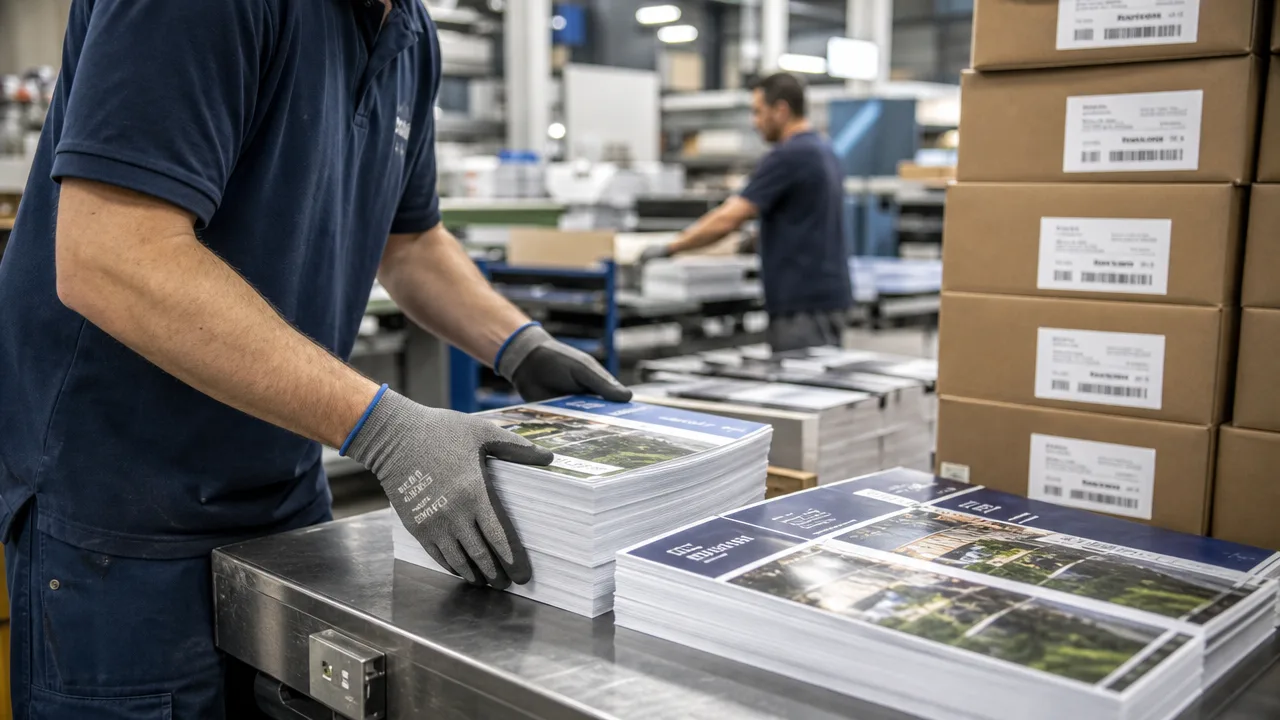
At Fretwell, all trade work is produced white-label: delivery notes, labels and packaging carry your reference, NDAs are standard on every trade account before work begins, and our own unmarked vans handle local and regional deliveries. Our plant list shows the full range of equipment, from B2 Heidelberg litho and Versafire digital presses to three Buhrs enclosing lines.
White-label print and mail for the trade
B2 litho, digital, finishing, large format, packaging and a full mailing house, all produced unbranded under NDA at our Keighley site.
Explore the serviceMailing work and your client's data
Direct mail is where trade work gets more involved, because it usually means passing your client's customer data to the producer. Under UK GDPR your client is normally the controller, you are their processor, and the trade printer handling the data is a sub-processor.
Sub-processors need the controller's authorisation
The ICO explains that a processor should not engage a sub-processor without the controller's prior specific or general written authorisation, and must put a contract in place giving the sub-processor the same data protection obligations. Check that your contract with your client allows you to use a mailing house, and that your trade printer will sign matching terms.
- Agree how data will be transferred (we use secure SFTP, with credentials supplied on request) and when it will be destroyed.
- Ask for the printer's information security documentation, so you can answer your client's procurement questions.
- Make sure pack integrity is verified, so the right letter reaches the right person. A wrong enclosure is a data breach as well as a reprint.
Our guides to data security for mailings and GDPR and direct mail cover the questions to ask, and what a mailing house does explains each stage of a mailing.
Briefing a trade job and supplying files
Most trade margin is lost to re-quotes, file problems and reprints. A complete brief and print-ready artwork prevent the majority of them.
- 1
Brief the full specification
Quantity and price breaks, finished size, pages and binding, stock, colours, finishes, proofing, delivery and deadline. Our free print brief template lists every field.
- 2
Choose the right process
Short runs, versions and personalisation usually suit digital; longer runs of the same artwork usually suit litho. See litho vs digital printing.
- 3
Pre-flight the artwork
Check bleed, safe area, image resolution, colour and fonts before files leave you. Use our print artwork checklist, with the reasons explained in how to set up artwork for print.
- 4
Check the proof properly
Your client signs off content, but you are approving production. Our proofreading checklist covers both.
- 5
Confirm delivery details
Give the delivery address, contact, any split deliveries and the reference that should appear on paperwork.
Trade pricing and turnaround
Trade pricing is usually agreed when an account is opened and reflects the volumes you expect to place. At Fretwell, trade pricing tiers are agreed at account setup, and estimates for standard specifications typically come back within a few hours. Complex jobs, such as multi-component packs, bespoke substrates or high-volume mailings, may take a working day.
| Work | Typical turnaround at Fretwell |
|---|---|
| Digital print | 2–5 working days |
| Litho print | 5–10 working days |
| Direct mail | 5–10 working days from approved artwork and data |